Restore Your Past
Unlock breakthrough preservation and restoration designed to crush dirt and secure your cards' victory
Restoring the Edge. Elevating the Grade
Defy factory flaws and surface grime—engineered care to win the slab and beat the population report
Services
-
Grading companies (PSA, BGS, CGC) view cards under magnification and raking light; loose particles or dried film can easily be mistaken for surface pitting, roller marks, or staining, unnecessarily knocking a card down from a Gem Mint 10 to a 9 or 8.5.
Non-Contact Dust Removal: Rubber bulb blower (rocket blower) or clean canned air held strictly upright at an angle (never shake the can to prevent propellant discharge).
Soft Brushes: Anti-static sable, goat-hair makeup brushes, or dedicated card-care dusters.
Microfiber Cloths: Edgeless, ultra-dense optical microfiber (minimum 300–400 GSM) or dedicated lint-free card cloths. Never use paper towels, tissue, or standard cotton, which contain wood fibers that scratch foil.
Specialized Media: TCG cleaning sponges/pads, microfiber tipped applicators, or dedicated hobby solutions (e.g., card-cleaning sprays designed to evaporate without leaving chemical residue).
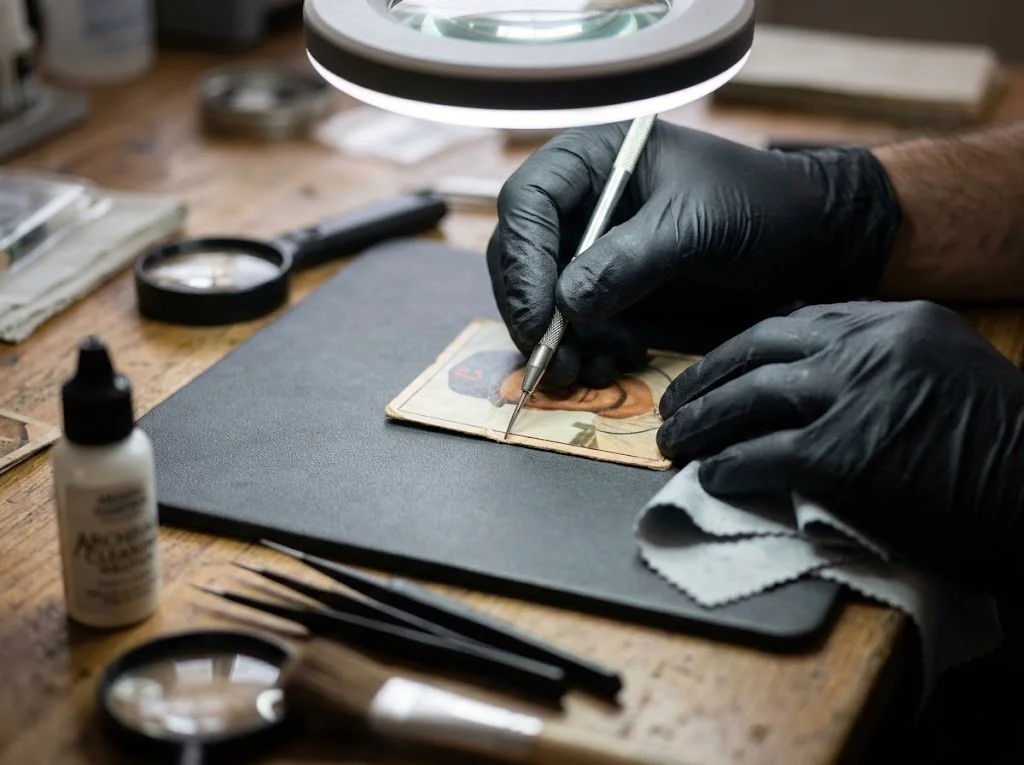
Inspection Light: Raking LED lamp (adjustable angle) and a 10×–20× lighted jeweler’s loupe.
-
In collectible card conservation and pre-grading preparation, edge lift correction refers to the mechanical and environmental realignment of separated or flared paper layers along a card’s perimeter to restore its factory-flat edge profile without compressing or altering the card stock.Description text goes here
Humidity Chamber / Micro-Climate Enclosure: An airtight acrylic or polycarbonate container equipped with humidity regulation (such as 60–65% two-way humidity packs) to relax cellulose fibers safely.
Specialized Edge Smoothing / Burnishing Tools: High-polish agate burnishers, PTFE (Teflon) bone folders, or silicone-tipped shaping pens. (Standard metal tools or rough wood bone folders can cause friction burn, gloss scuffing, or micro-dents).
Barrier Media: Acid-free, ultra-smooth release paper (such as silicone release liners, glassine, or specialized card-safe mylar film) to ensure burnishers never make direct contact with raw card ink or foil.
Controlled Clamping / Pressing Rigs: Precision acrylic leveling blocks, neoprene cushioning shims, and uniform-pressure card presses or calibrated screw vices.
Inspection Optics: 10×–30× stereo microscope or lighted jeweler’s loupe to verify layer realignment and check for core-fiber stress.
Under grading inspection (PSA, CGC, BGS), an edge lift disrupts the smooth silhouette under raking light, casts a shadow, exposes the white inner core, and is frequently penalized under both Edges and Corners subgrades.
-
DescripDents are among the most punitive surface defects at major grading companies (PSA, BGS, CGC). Unlike a simple surface scuff, a dent disrupts the card’s physical plane and casts a distinct shadow under oblique raking light, routinely capping a card’s Surface subgrade at an 8 or dropping an otherwise pristine modern card straight to a PSA 6 or 7.tion text goes here
Micro-Humidity Delivery Systems: Controlled humidity chambers (58%–65% RH) or precision ultrasonic cold-mist micro-applicators. Liquid drops must never touch the card.
Optical Inspection Setup:
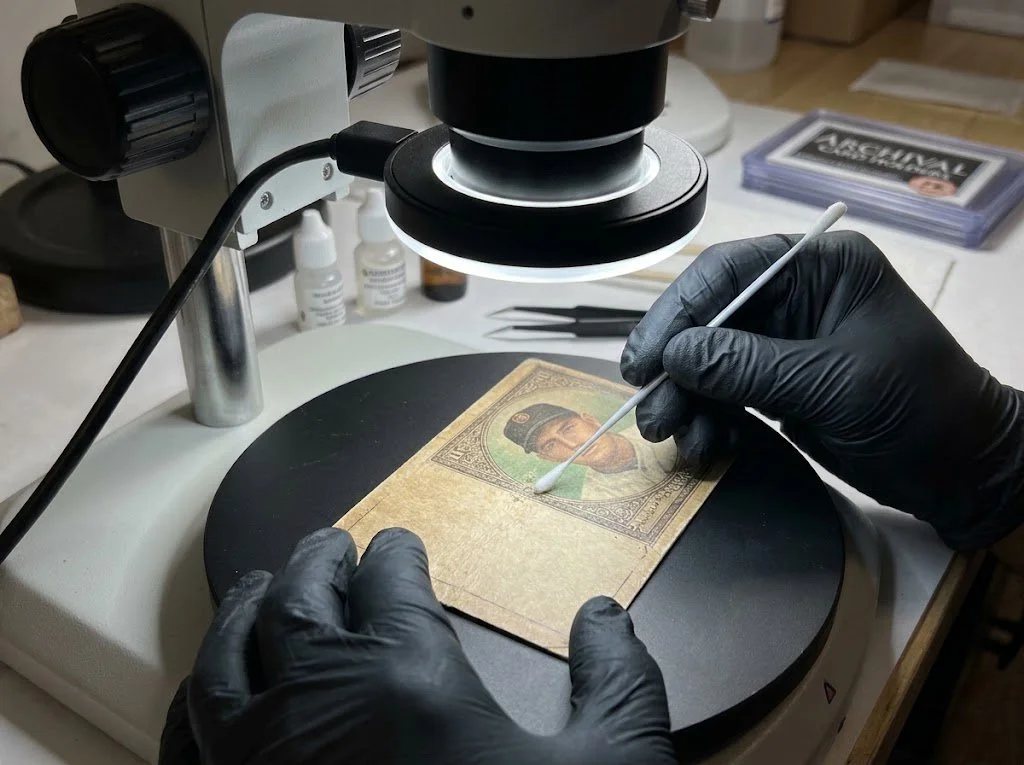
High-magnification stereo microscope or digital inspection scope (10×–40×) to inspect fiber integrity at the trough and perimeter of the dent.
Low-angle, directional raking LED lighting to evaluate shadow depth before, during, and after treatment.
Precision Smoothing Tools: High-polish synthetic sapphire or agate burnishers, PTFE (Teflon) rounded smoothing points, and silicone micro-shapers.
Protective Interleaving Media: Zero-texture, biaxially oriented PET film (Mylar/Melinex), glassine, or silicone-coated release liners to prevent transferring surface texture or creating friction rub on delicate factory finishes.
Calibrated Mechanical Flattening Rigs: Precision-machined optical acrylic or aircraft-aluminum leveling plates paired with uniform-pressure screw presses or dead-weight leveling setups.
-
While a heavy crease that fractures the paper core or cracks foil leaves permanent structural scarring, a surface wrinkle (often caused by minor flexure, pocket strain, or humidity buckling where the ink/foil layer has shifted or bubbled without breaking) can be substantially minimized. Because graders penalize creases and wrinkles heavily—often capping grades at EX 5 or VG-EX 4—properly flattening the surface relief can restore the card's planar integrity and dramatically improve eye appeal.
Controlled Micro-Humidification: Indirect ultrasonic vapor chambers or sealed RH chambers (62%–68% RH). Direct water contact or liquid misting is strictly forbidden to prevent watermarks and ink bleeding.
Precision Thermal Tools: Temperature-calibrated conservation tacking irons or heated spatula tips with digital P.I.D. micro-controllers (operating in the safe range of 105°F–130°F / 40°C–55°C).
Ergonomic Burnishers & Massage Tips:
High-polish natural agate burnishers (zero micro-porosity to eliminate friction drag).
Rounded PTFE (Teflon) styling probes.
Medical-grade silicone micro-shaping tips for soft, pliable pressure delivery.
Interleaving & Thermal Diffusion Barriers:
Non-stick, high-temperature PTFE release film.
Archival-grade siliconized glassine or ultra-smooth 2-mil biaxially oriented PET film (Melinex/Mylar).
Compression Rigs: Aircraft-grade precision ground aluminum or thick optical cast-acrylic leveling blocks paired with weighted or screw-clamped card presses.
-
While a surface wrinkle primarily involves minor layer buckling, a crease represents severe mechanical trauma where the card stock has folded past its elastic limit, causing localized fiber compaction on the inside of the fold and fiber fracture (tension failure) on the outside.
Vapor Conditioning Chamber: Sealed micro-climate chamber capable of maintaining 65%–70% relative humidity (RH) to thoroughly soften dense core fibers without surface wetting.
Specialized Conservation Irons: Digital, micro-tip tacking spatulas with accurate P.I.D. temperature regulation (calibrated within 110°F–125°F / 43°C–52°C).
High-Density Leveling Blocks: Hand-lapped optical cast acrylic or precision-machined 6061 aluminum blocks (minimum 0.75-inch thickness to eliminate flexure).
Fine Smoothing Tools: Polished natural agate burnishers (flat knife edge and rounded ball ends) and virgin PTFE bone folders.
Micro-Barrier Films:
2-mil optical grade biaxially oriented PET film (Melinex 516).
High-temp non-stick PTFE transfer sheets (prevents ink pickup or gloss melting under heat).
High-Tension Mechanical Press: Heavy-duty, balanced dual-plate screw press or calibrated dead-weight system delivering uniform, repeatable pressure across the card plane.
-
Unlike a localized edge lift (where a cut factory burr or single layer separates slightly), a folded edge involves all laminates—the face print/foil, the opaque central core, and the back paper layer—bending past their yield point along the card border. If left untreated, a folded edge catches inside penny sleeves, accelerates paper splitting, and severely damages both the Edges and Corners subgrades at grading companies like PSA, BGS, and CGC.
Precision Unfurling Probes: Micro-spatulas with micro-beveled, polished edges, or flexible micro-tweezer probes with smooth, non-serrated tips to slip under folded flaps without gouging paper.
Perimeter Burnishing Tools: Cylindrical and wedge-tip natural agate burnishers or high-density PTFE (Teflon) smoothing tools.
Digital Edge-Tacking Tool: Temperature-controlled mini tacking iron with ultra-fine rectangular or knife-edge tips (regulated precisely between 110°F–122°F / 43°C–50°C).
Guiding Blocks & Precision Straightedges: Polished optical glass or aircraft-grade 6061 ground aluminum square blocks to act as a physical lateral backstop (fence) during edge realignment.
Barrier Media: 2-mil optical Melinex (PET) release sheets and non-stick high-temp PTFE film.
Optical Inspection: 20×–40× stereo microscope or high-definition macro digital scope with low-angle directional raking illumination.
-
In collectible trading card conservation and grading preparation, holographic correction refers to the specialized decontamination, optical clarifying, and planar stabilization of the delicate metallized polyester (PET) film layer on foil cards to eliminate clouding, fine surface haze, micro-abrasions, and localized foil warping without compromising the factory luster.
Zero-Abrasion Optical Cloths: Edgeless, split-fiber microfiber with ultra-fine split filaments (greater than 400 GSM, 80/20 or 70/30 polyester-to-polyamide blend). Cloths must be washed with residue-free, fragrance-free detergent and inspected under magnification for stray debris before touching foil.
Micro-Foam Cleaning Swabs: Polyurethane closed-cell foam swabs or precision micro-applicator tips (cotton swabs are avoided because natural cotton fibers can shed and cause micro-abrasions under pressure).
Optical Inspection Platform:
High-CRI (95+) dual-temperature adjustable LED lamp (5000K daylight balanced).
360-degree pivoting low-angle raking light to inspect for swirl marks, film residue, and depth of scratching.
10×–40× digital inspection microscope.
Neutral pH Decontamination Solutions: Ultra-pure, residue-free specialized card solutions that flash-evaporate without leaving an oily film or stripping factory UV curable inks.
Humidity Equalization Rig: Two-way humidity chambers equipped with 55%–62% RH regulators to address foil tension curl without thermal stress.